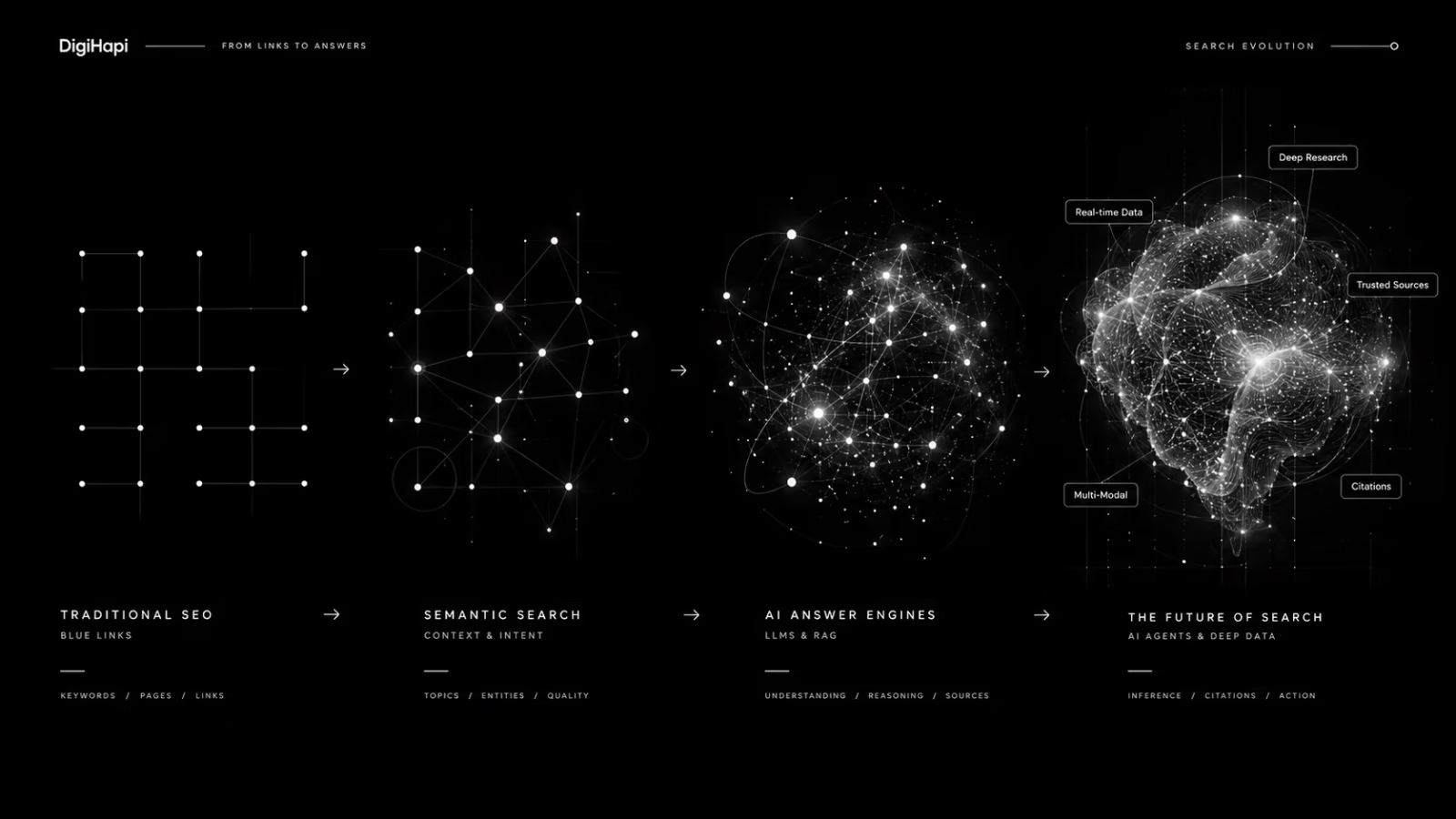
It’s time to settle the debate and look at the reality of search: the landscape has fundamentally changed. We are no longer in the era of the “10 blue links.”
Today, over 58% of searches end without a click, as the search engine itself supplies the answer. Meanwhile, AI-native answer engines like ChatGPT and Perplexity are handling billions of queries monthly, growing at an unprecedented rate.
The result? The optimization playbook has expanded. It’s no longer just about “earning the click” (SEO). It’s about “winning the citation and powering the action” (AEO). At Digihapi, we don’t see AEO as a replacement for SEO, but as its inevitable, necessary evolution.
AEO vs. SEO: The Fundamental Difference
While the user’s end goal remains the same (finding an answer or making a purchase decision), the engines operate differently, requiring distinct optimization tactics.
- SEO (Search Engine Optimization) aims to rank your page in Google’s organic results. Googlebot primarily reads HTML, PDFs, and traditional web structures.
- AEO (Answer Engine Optimization) focuses on providing the most direct, concise, and reliable answer possible, so it can be cited verbatim by a Large Language Model (LLM) like ChatGPT, Gemini, or Perplexity.
The Technical Shift: Speak the Language of Machines
This is where most businesses fail. Googlebot and LLMs do not “read” your site the same way.
LLMs excel at extracting structured data. This means that schema markup (Schema.org), FAQs, JSON-LD, and low-latency APIs are often more important for AEO than raw HTML prose.
This is exactly why we systematically implement an LLMs.txt file for our clients. Just as robots.txt guides traditional crawlers, LLMs.txt explicitly tells AI models how to safely parse, synthesize, and cite your content without hallucinations.
The Digihapi Playbook: The SEO + AEO Overlap
Ignoring SEO starves AEO (since well-ranking pages supply the training data for AI). But ignoring AEO means ignoring the fastest-growing search surface. Here is how we fuse both disciplines:
- From E-E-A-T to H.E.E-A-T: We add Helpfulness to Expertise, Experience, Authoritativeness, and Trustworthiness. Content must solve the user’s problem immediately.
- Content Chunking: We write 40-to-90-word blocks that answer questions directly. Every H2 should be a self-contained answer that an AI can easily copy and paste.
- Source Diversity: Over 60% of AI Overview citations come from non-traditional sources (Reddit, niche forums, industry reports). We help our clients seed their expertise where AI models actually pull their data.
- Advanced Technical Hygiene: Implementing
LLMs.txt, keeping timestamps strictly updated (freshness is a massive ranking factor for AI), and pruning outdated content to avoid negative freshness signals.
The Next Horizon: Optimization for Agentic AI
The horizon doesn’t stop at answers. AI is becoming agentic. Tools can now navigate websites, pre-fill forms, and schedule meetings autonomously.
The brands that already expose machine-readable endpoints and clear LLMs.txt permissions will be chosen first by these agents.
Don’t just settle for being visible on Google. Make sure you are the source of truth that AI recommends and acts upon.
Ready to future-proof your digital presence?
Let’s audit your website’s readiness for the AEO era and build an infrastructure that scales.